

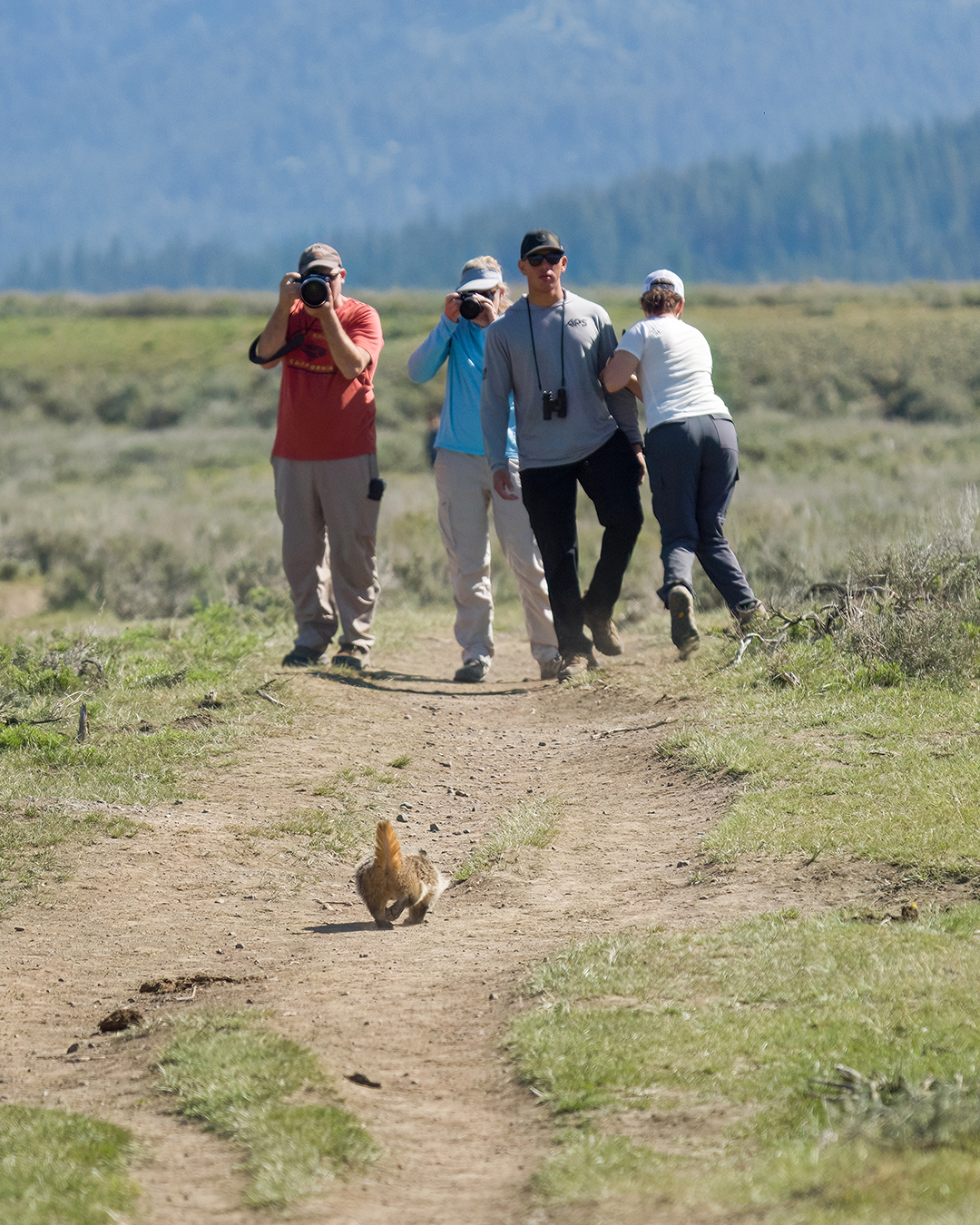
“That guy is too close to the badger.”
The speaker was a Yellowstone hiking guide addressing his clients, and “that guy” was me. I considered pointing out that the guide’s large group and loud talking seemed to be affecting the badger more than I was, but I refrained, mostly because he was probably right. I thought I was roughly 25 yards away from the badger, consistent with park rules, but I might have been closer.
“You were closer,” Greg told me later (and, given that Greg coached high school football, I humbly deferred to his superior ability to judge 25 yards of distance). Greg and Jill, our friends and Silver Gate neighbors, had joined me that morning to look for badgers in Lamar Valley. I’d stumbled across a badger den the previous morning – not a regular burrow, but a natal den, where a badger mom was raising three cubs – and we were hoping to see the family.

The badger cubs weren’t out, but we did catch a glimpse of the mom running up a slope and vanishing into the sagebrush. Eventually we found the mom darting around the sage, changing direction often as she hunted ground squirrels. Kneeling down to get eye-level photos, I had to back off when the mom trotted towards me before she stopped to excavate a ground squirrel burrow. Apparently, though, I didn’t back off far enough.


Hours later I was still thinking about the guide’s comment. It wouldn’t have rankled so much if he hadn’t hit a sore spot. More and more lately, I’ve been struggling with an uncomfortable contradiction in my relationship to wildlife. On the one hand, I love wild animals and get immense joy from watching and photographing them. And on the other, I think it’s indisputable that exposure to humans, in general, tends to have a negative impact on wildlife. So doesn’t that mean I’m harming the animals I profess to love?
I’m certainly not the first person to wrestle with this. It’s a topic I bring up often with other Yellowstone regulars, and everyone seems to have their own way of rationalizing the dissonance. Here are some of the most common arguments I’ve heard, followed by a counter-argument:
“Net Positive” Argument. Some wildlife watchers admit they might be doing a little bit of harm by habituating the animals, but they believe that the photos/videos/stories they capture and share encourage other people to care more about protecting the natural world, which nets out as a positive impact overall.
“Net Positive” Counter-Argument. It’s nearly impossible to make this argument when your audience is as small as mine, but even for people with a massive number of followers it strikes me as being uncertain and impenetrably abstract. Let’s use Tom Mangelsen, a well-known wildlife photographer based in Jackson, Wyoming, as an example. I’ve never met Tom, but my understanding is that he’s a good person who cares passionately about wildlife. His work reaches a lot of people and helped turn grizzly bear 399, “the Queen of the Tetons,” into a celebrity. I have no doubt that Tom’s photos and videos have led many people to care more about bears and other animals, but those same images contributed to making 399 so popular that she began attracting huge, problematic crowds. Who can say if the net impact of all that has been positive or negative? And even if you believe that outliers like Tom (or Paul Nicklen) have done so much good that their impact is clearly net positive, how many of us can claim to be in such rarefied company?
“Whataboutism” Argument. Some people argue that whatever small bit of harm they might do is meaningless when you look at the truly terrible things other people do. Maybe I’m contributing in some miniscule way to the habituation of this wolf/bear/moose, they might say, but it’s not like I’m feeding it, or trying to pet it, or chasing it down with a snowmobile, or whatever.
A different slant on this argument points out that it’s essentially impossible to exist as a person these days without doing harm to the natural world. All non-vegetarians kill animals for food. Charging your phone, flying on a plane, and heating your house all contribute to climate change. And any time you drive a car you’re warming the planet while also running the risk of accidentally hitting an animal on the road. Unless you live in an off-grid mud hut, walk everywhere, and only eat plants, you’re already part of the problem.
“Whataboutism” Counter-Argument. It’s a logical fallacy to claim that your bad behavior is fine because other people are doing something worse, or that doing one kind of harm makes it OK to do another kind. Which isn’t to say that degree of harm is irrelevant. If you feed a wild fox, that almost certainly causes more harm than if you just observe the fox from 25 yards away. And if you eat steak for dinner every night, you’re contributing more to climate change and killing more cows than if you only have steak once a week. Doing less harm is better than doing more.
“It’s the Animal’s Choice” Argument. Wild animals sometimes choose to be close to humans. Food availability, obviously, can play a big role, but there are lots of other potential reasons. I’ve heard that bear moms sometimes hang out by roads as a way to reduce the risk of male bears killing their cubs. Similarly, fox moms sometimes choose den sites near humans to reduce the risk of coyotes killing their kits. And therefore, the argument goes, animals that make a choice to be near humans have to take the bad with the good.
“It’s the Animal’s Choice” Counter-Argument. It’s true that someone who moves to a city with a lot of smog needs to accept that they’ll be breathing low-quality air, but that doesn’t make it OK for their neighbor to dump trash in their yard. Likewise, a fox mom that chooses a den site by a road does seem to be accepting a higher risk that her kits will be hit by a car. That’s part of the trade-off she’s making. But an individual who chooses to stop at the den to watch or photograph the foxes is still causing harm by contributing to their habituation.
The fox den example is more than just a hypothetical for me – this spring I realized that a close-to-the-road fox den I’ve watched in previous years was active again, and I had to decide how to handle it. The kits would have been better off if I’d left them alone entirely. But I didn’t. I spent a few days watching the kits, taking photos, and doing my best to avoid being seen by anyone else. When young fox kits are spilling out of a den like that, I can’t think of many places in the world I’d rather be.


After that, unfortunately, the fact that the fox den was active became broadly known. I’m not entirely sure how it happened, but I heard that some photographers spotted the fox mom by the road and were taking shots when a few tiny kits unexpectedly burst onto the scene. The photographers passed that information along to friends, who told others, and very quickly the den was surrounded by a semi-circle of 30+ photographers hunkered down behind tripods. I stayed away, not wanting to contribute to the circus. The crowds were so disruptive that it only took a day or two for the park to close down the entire area, which thankfully gave the fox family a long stretch of peace and quiet.
“Spotting Scope” Argument. People who primarily view wildlife through spotting scopes from far away, like many of the wolf watchers in Yellowstone, sometimes argue that they’re too distant from the animals to be habituating them in any meaningful way.
“Spotting Scope” Counter-Argument. There’s truth here, I think, connected to the idea that degree of harm matters. Watching wolves from a mile away almost certainly habituates and disturbs them less than a photographer who tries to get as close as possible. But even people using spotting scopes are sometimes visible to the animals they watch, and, whether you’re watching a wolf through a scope or taking photos from 100 yards away, you’re still making the wolf more comfortable with humans pointing long metal tubes at it, which isn’t great if that wolf decides to leave the park during hunting season.
So where does that leave us? If it isn’t already obvious, I haven’t yet found a convincing argument that wildlife watching and photography don’t negatively impact the animals. But some of the arguments do point to ways the impact can and should be mitigated.
For me personally, it’s important to accept and own the fact that there’s a fundamental selfishness to my wildlife watching and photography. I can’t rationalize it away. It would be better for the animals I love if I just left them alone, and I don’t.
What follows, then, is the necessity of keeping my impact small enough that I can live with the amount of harm I’m causing. I already do the obvious stuff, of course. I don’t feed or bait wildlife (although at our home in Silver Gate, I do feed the birds and throw an occasional peanut to a squirrel we call Scraps). I try my best not to draw attention to sensitive sightings like active nests or dens. I don’t get egregiously close to animals, and I back off if my presence seems to be disturbing them. (I realize that many of my photos make it look like I was right up in the animal’s business, but keep in mind that I usually shoot with a 600mm lens and then crop the image, which makes far away things appear much closer.)
The distance issue is tricky, and I’ve mishandled plenty of situations. In early May, for example, I was walking from Tower Junction up to Calcite Springs when I ran into a black bear grazing by the road. It was a bear I’d encountered many times over the previous couple of weeks, and it never seemed even slightly bothered by my presence. There were slopes on both sides of the road that would have made it difficult to walk past the bear without getting closer than I wanted, and the bear seemed to be in no hurry to move. I should have waited or turned around, but instead I just walked right by, giving the bear as much space as I could but still not enough. Nothing happened – the bear didn’t even raise its head. But regardless, what a stupid thing to do. I fell into the trap of thinking that I knew this bear well enough to predict its behavior, but how can anyone really know where the line is that causes a specific bear to flip the switch and become aggressive? I regretted it immediately. I never should have put myself or the bear at risk like that. Eliminating those kinds of mistakes is one significant way I can do a better job of reducing my impact.

In general, I think Yellowstone’s wildlife distance rules (stay at least 100 yards from wolves and bears and 25 yards from other animals) strike a reasonable balance. Adding more nuance might better reflect reality, but keeping it simple is the right priority. Grizzlies warrant more space than black bears, for example, but how many casual visitors can easily tell them apart? The one addition to the rules that I and many others would make, however, is that any distance is too close if you’re bothering the animal. And, as with all rules, some common sense interpretation is required. If we had to stay 25 yards away from ground squirrels, for instance, it would be virtually impossible to hike in Lamar Valley in the summer.

Aside from the distance misjudgment that earned me a scolding from the hiking guide, I usually didn’t find it too difficult give the badger mom 25 yards of space as I watched her raise her three cubs over the second half of May. It was my first opportunity to observe a badger family over an extended period of time, and I could hardly believe my luck. The natal den bordered a popular trail, and countless hikers cruised by without realizing they were passing directly over four badgers. Whenever a hiker did happen to notice the badgers, their most common reaction was to yell, “What are those things?!”


I watched the badger mom play with her cubs, hunt ground squirrels, deal with humans, and engage in a dispute with another adult badger that lasted three days. The other badger showed up near the natal den one morning, which prompted the mom to go over and express her displeasure. As the two scuffled, one of the cubs suddenly appeared out of nowhere (drawn over by the sounds of fighting?), forcing the mom to take a break to return the cub to the safety of the den. I guessed the adults were having a territorial conflict of some kind, but most of what was happening was a total mystery to me.


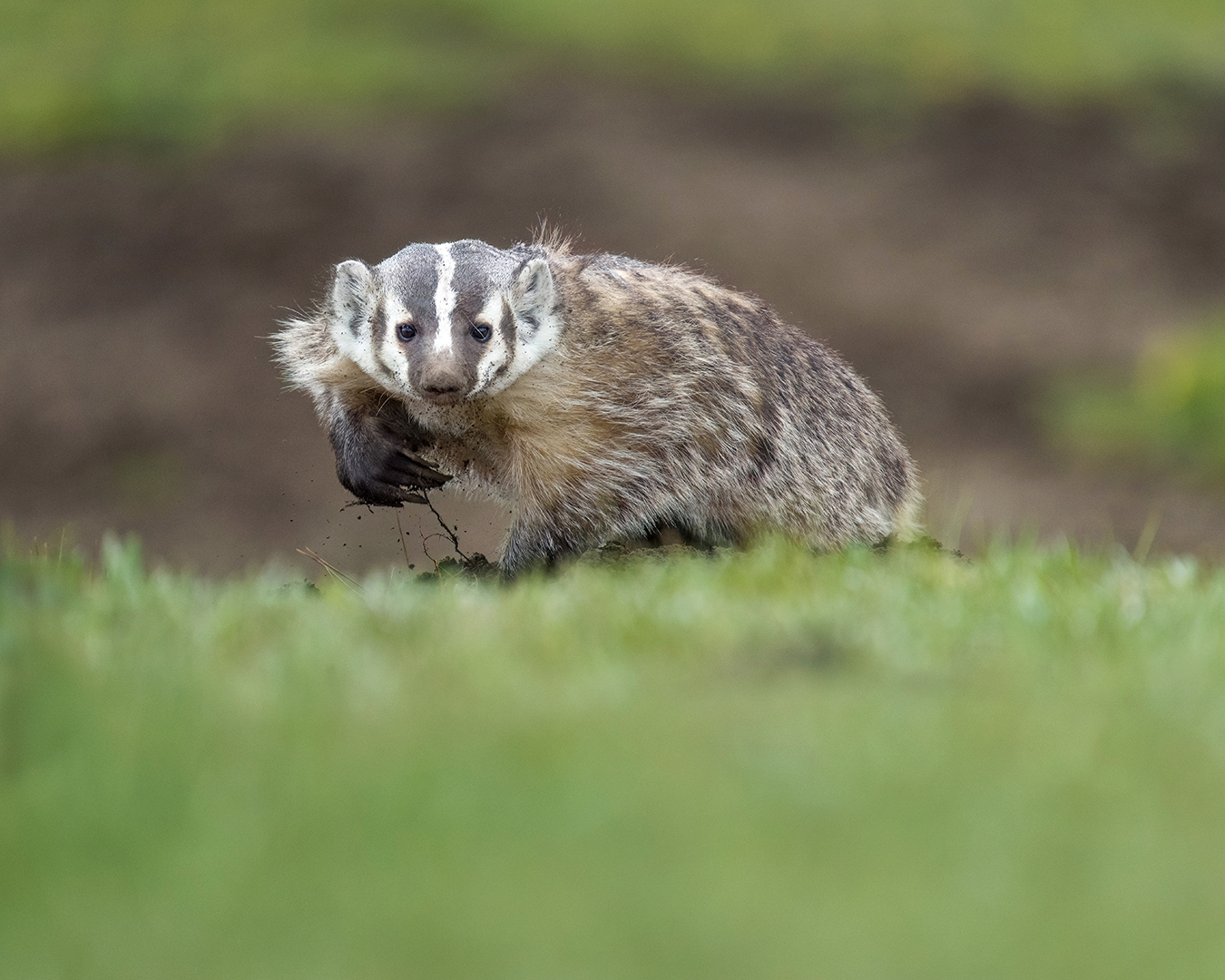


Initially the cubs didn’t do much more than pop out of the den when their mom was around, but they grew bolder every day, and after about a week they began joining their mom on brief excursions. In late May the family relocated to a new burrow, and a couple of days later they moved again.


I spent so much time watching the badgers that I couldn’t help but appreciate the birdlife in the area, too, including meadowlarks, sandhill cranes, and a large bird of prey that turned out to be an American Goshawk, the first I’d ever seen.


My mom came for a great visit in early May – before I discovered the badger den, unfortunately – and we had good luck finding wildlife, including lots of black bears, double-digit grizzlies, moose, wolves, foxes, coyotes, bighorn sheep, elk, bison, pronghorn, sandhill cranes, osprey, a peregrine falcon, a bald eagle, and much more. One morning we watched through a scope as a grizzly mom with a cub skirmished with several wolves near one of the Junction Butte dens. And at 87, my mom had no trouble hiking up to Trout Lake, where we found two swans, something I’d never seen there before, as well as a moose mom and calf that forced us to turn around on the trail so they could continue using it.


Figuring out the best way to watch and photograph wildlife while keeping my impact tolerably low doesn’t feel like the kind of dilemma that gets solved definitively. It’s more of an ongoing challenge. My perspective will continue to evolve, hopefully, and if anyone with relevant experience has advice or insight they’re willing to share, I’d genuinely appreciate it.


Fabulous post, excellent photos, useful tips about distance, excellent plus-minus evaluation. Thank you!
LikeLiked by 1 person
Thank you!
LikeLike