
I’ve noticed that wildlife photographers who visit Yellowstone regularly (including me) often follow a three-stage pattern.
At first – when we’re relatively new to the park – we’re all fired up to photograph the megafauna, particularly bears and wolves. And why not? Bears and wolves are incredible, and Yellowstone is one of the best places in the world to see them in the wild. The thrill of photographing such iconic animals never gets old. That’s Stage One.
Stage Two kicks in when we find ourselves increasingly intrigued by mustelids, a family of carnivores that includes otters, weasels, badgers, and martens, among others. Capturing good shots of mustelids, it turns out, can be a different kind of challenge than photographing bears and wolves. Many would argue that the Holy Grail of wildlife photography in Yellowstone is getting a shot of a wolverine, the park’s most elusive and rarely-seen mustelid.
Stage Three finally sneaks up when we catch ourselves saying something like, “I’m not really into birds, but owls are pretty amazing.” The next thing we know the dead branches of fallen trees are ripping holes in our clothes as we tromp around the backcountry all day in the hope of catching a glimpse of a Great Gray Owl. There’s an inevitability to it.
I began my drift into Stage Three a little over a year ago, thanks mostly to some Yellowstone regulars – Nick, Jort, and Todd – who all reached the owl stage long ago. The triggering event for me was a Great Gray Owl’s extended visit to the Silver Gate/Cooke City area in December 2022. As we watched and photographed that owl, Jort and Nick provided me with a crash course on Great Gray behavior. Captivated by the owl but disappointed with the shots I got, I vowed to do better.
I had a chance to follow through on that vow last year when Nick was kind enough to let me tag along on a few of his backcountry searches for Great Grays. I did end up with holes in my jacket, but it was more than worth it to benefit from Nick’s experience and capture decent shots of a Great Gray in flight.
Flash forward to this past January, when Nick mentioned that he’d spotted a northern pygmy owl in Lamar Canyon. This was big news for a Stage Three rookie like me who’d never even seen that species of owl before. Nick and I searched Lamar Canyon unsuccessfully a couple of times before Marie and I headed overseas for most of February.
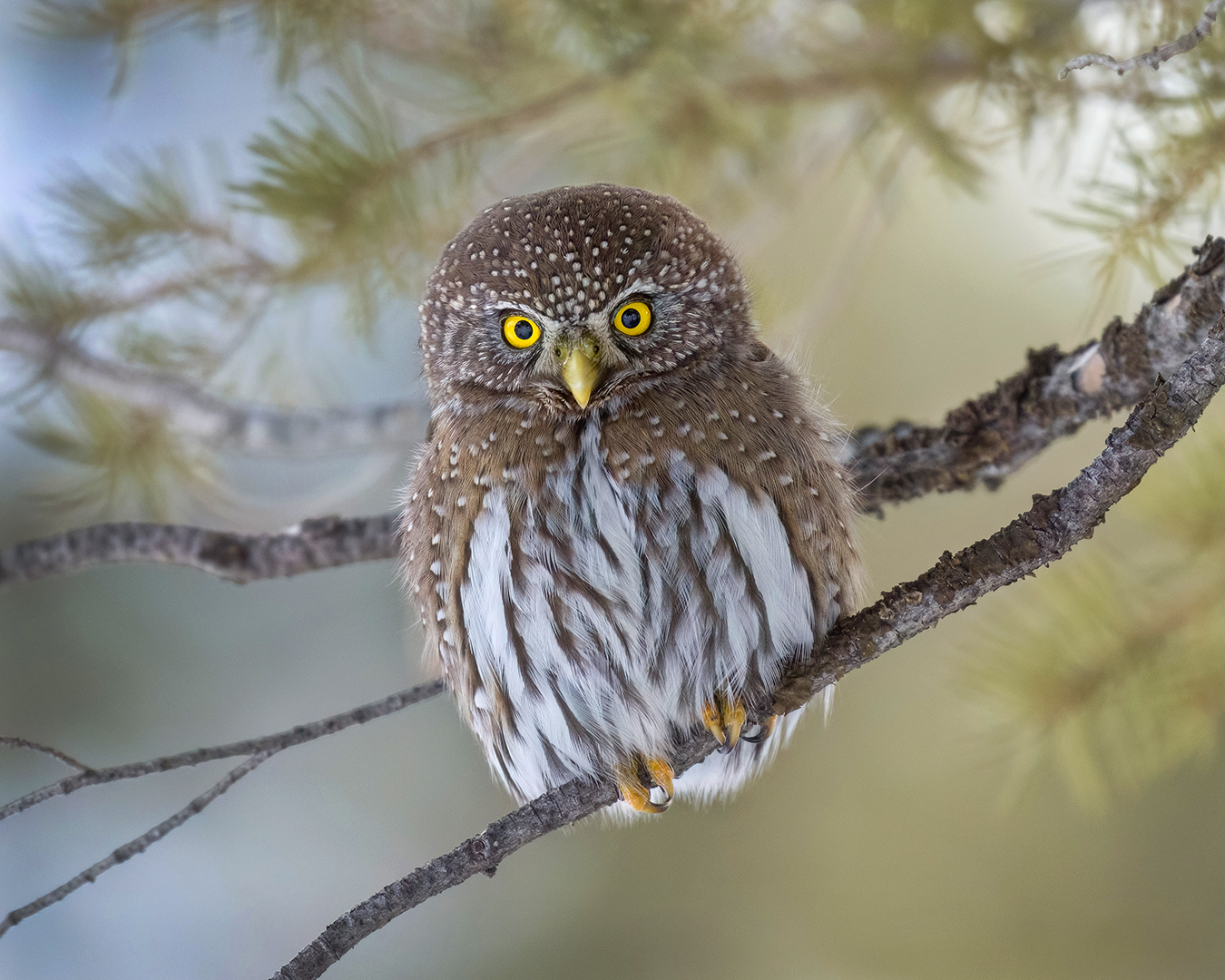
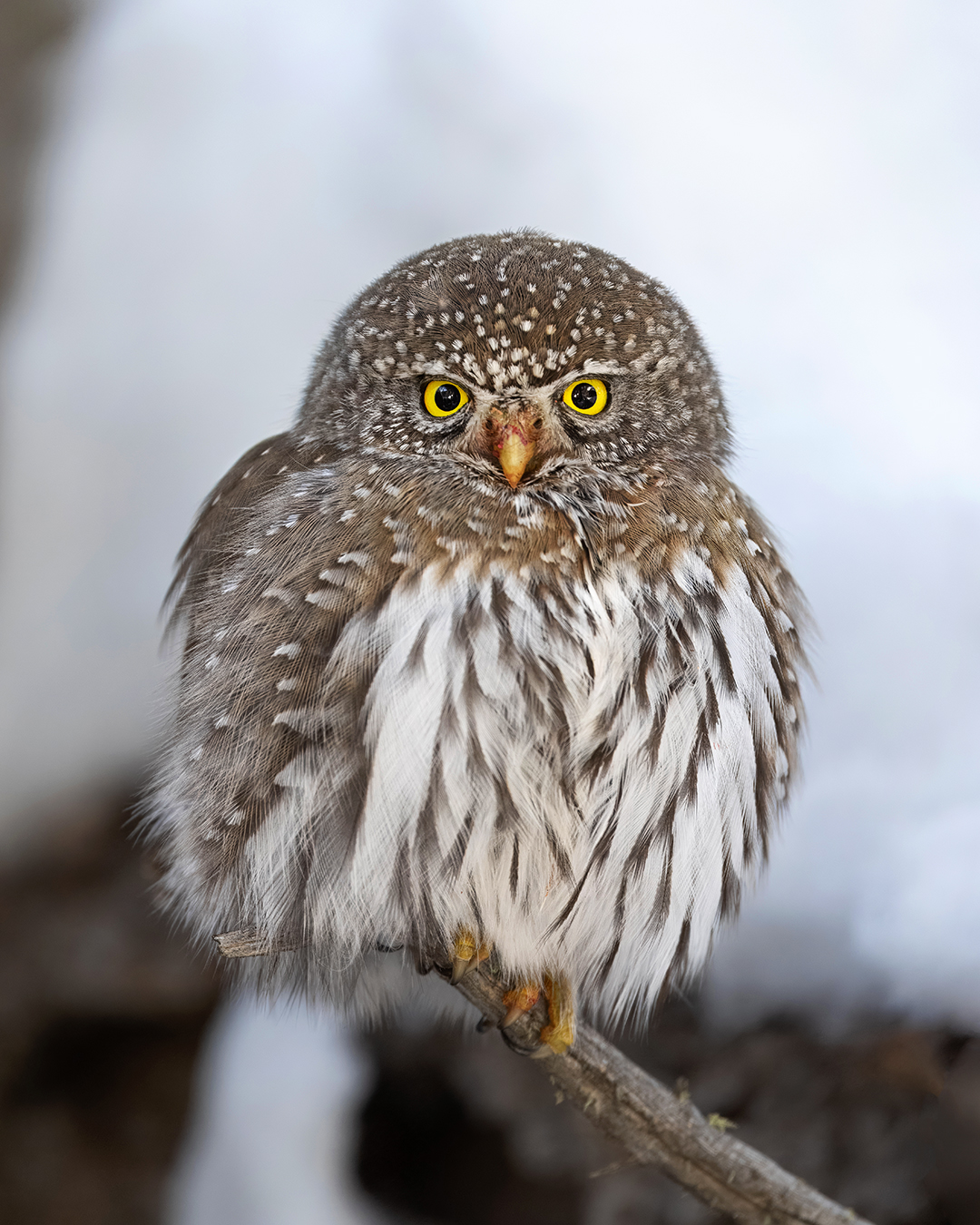
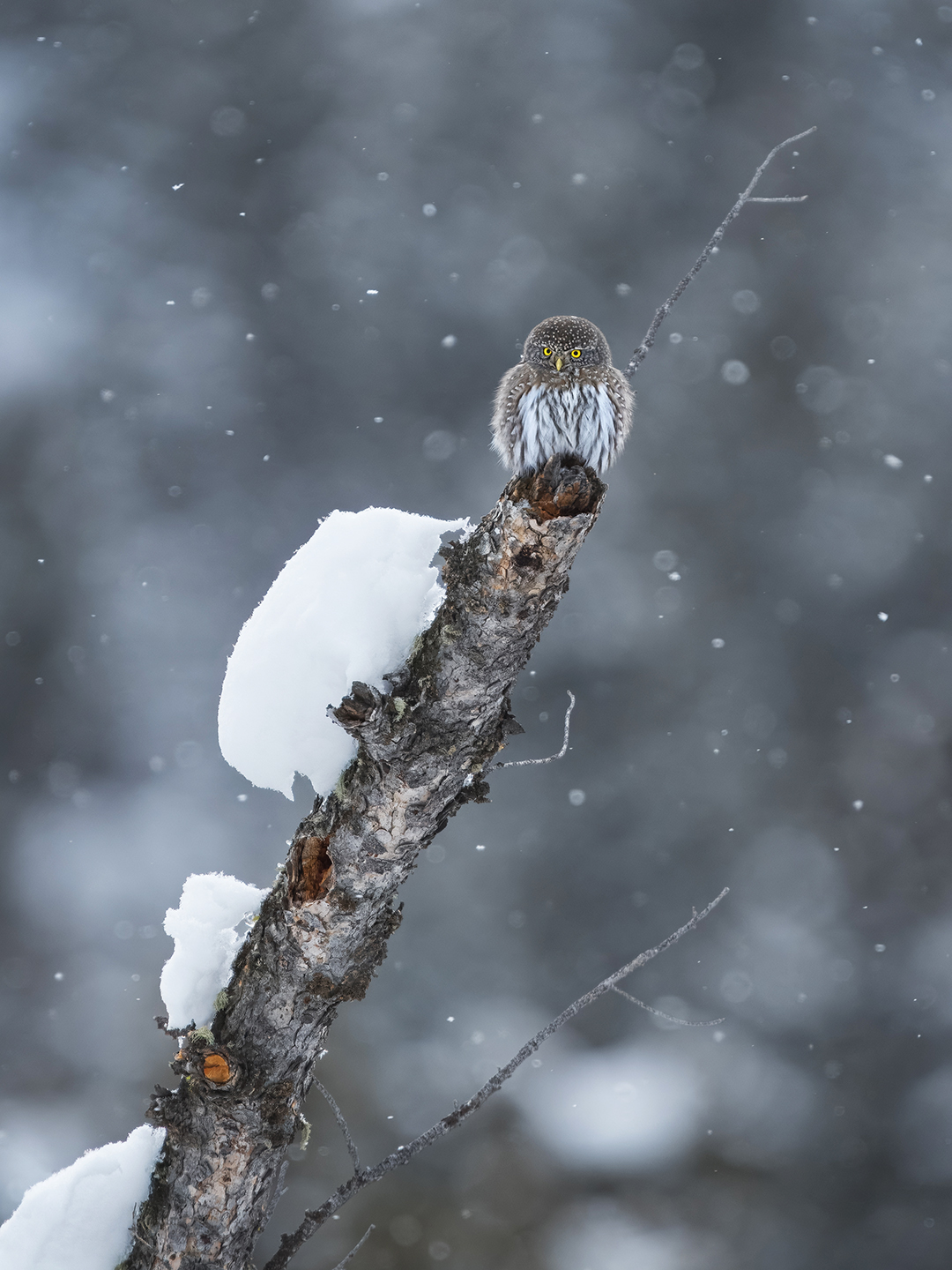
When we returned home from our trip I spent a couple mornings looking around Lamar Canyon without any luck. And then finally in early March I spotted a telltale silhouette high on a dead branch – my first pygmy owl! There’s no chance I would have seen it if Nick hadn’t explained where to look and what to look for (“They’re basically the size and shape of a Clark’s nutcracker with its head chopped off…”). How many pygmies must I have passed by over the years?
I parked at the nearest pullout and scrambled up a hill to get a closer view. As I watched, the owl bolted from its perch, vanished behind some brush, and reappeared with a rodent clutched in its talons. I couldn’t believe my luck when it landed on a low branch not far from where I stood. I fired off some shots and then looked away for a few seconds to reposition myself. When I turned back the pygmy was gone.
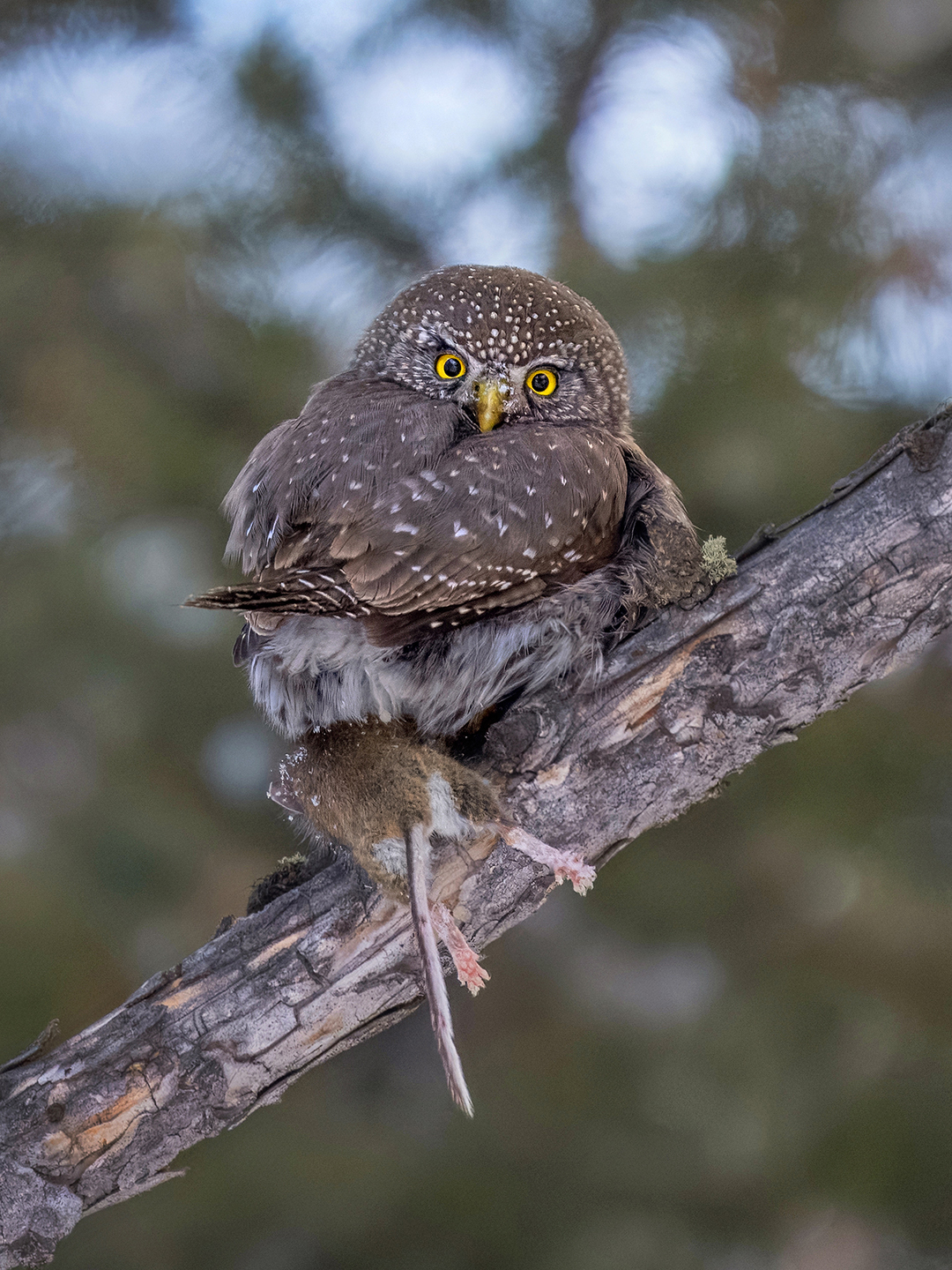
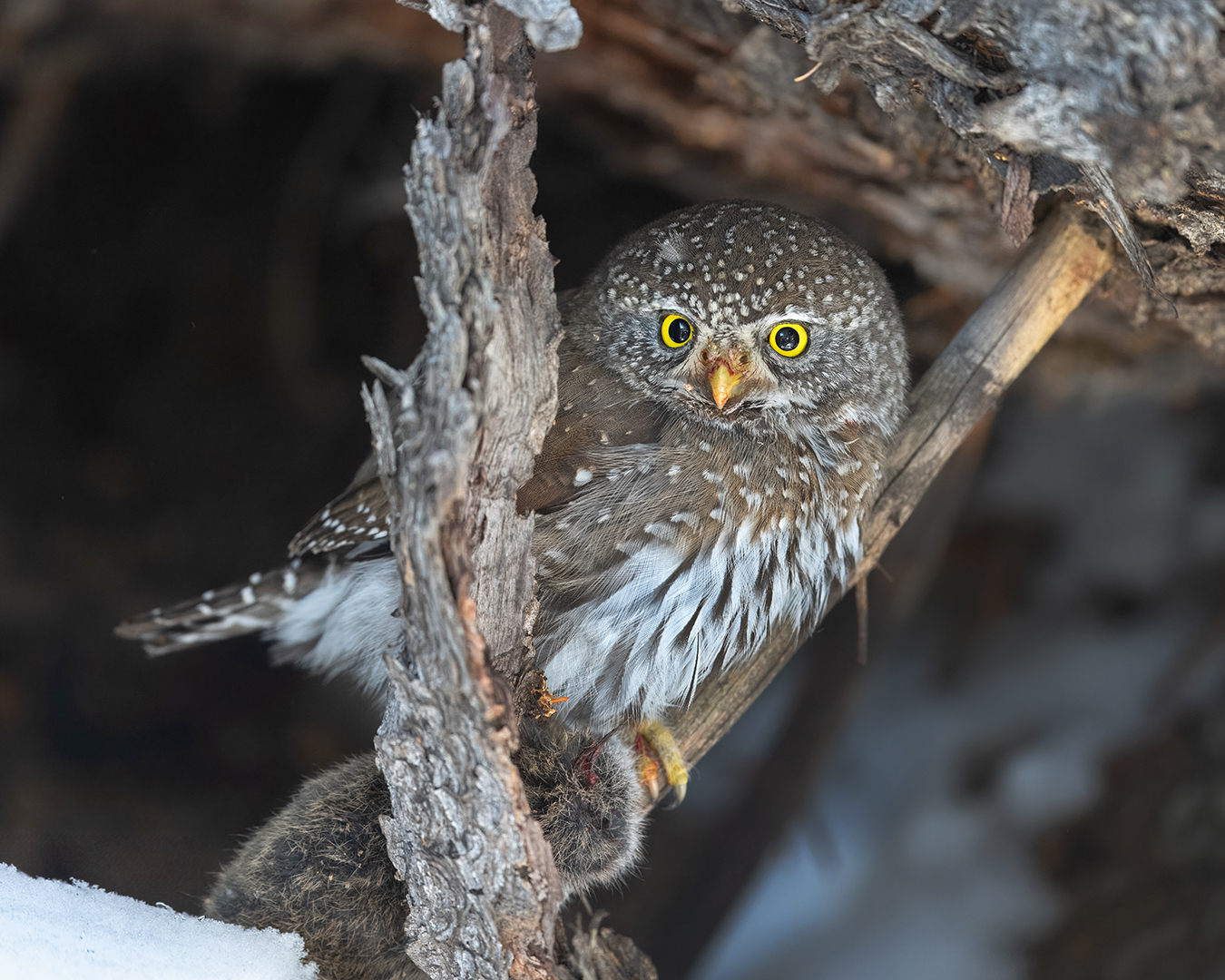
Charged up by this brief encounter, I returned to Lamar Canyon the next morning and found the owl right away, this time perched high on the other side of the road. Todd happened to be driving past, and – hearing that I had the pygmy – stopped to join me. We only needed to wait a short time for the owl to make what turned out to be a successful hunting dive before returning to a branch to pose with its newly-caught rodent.

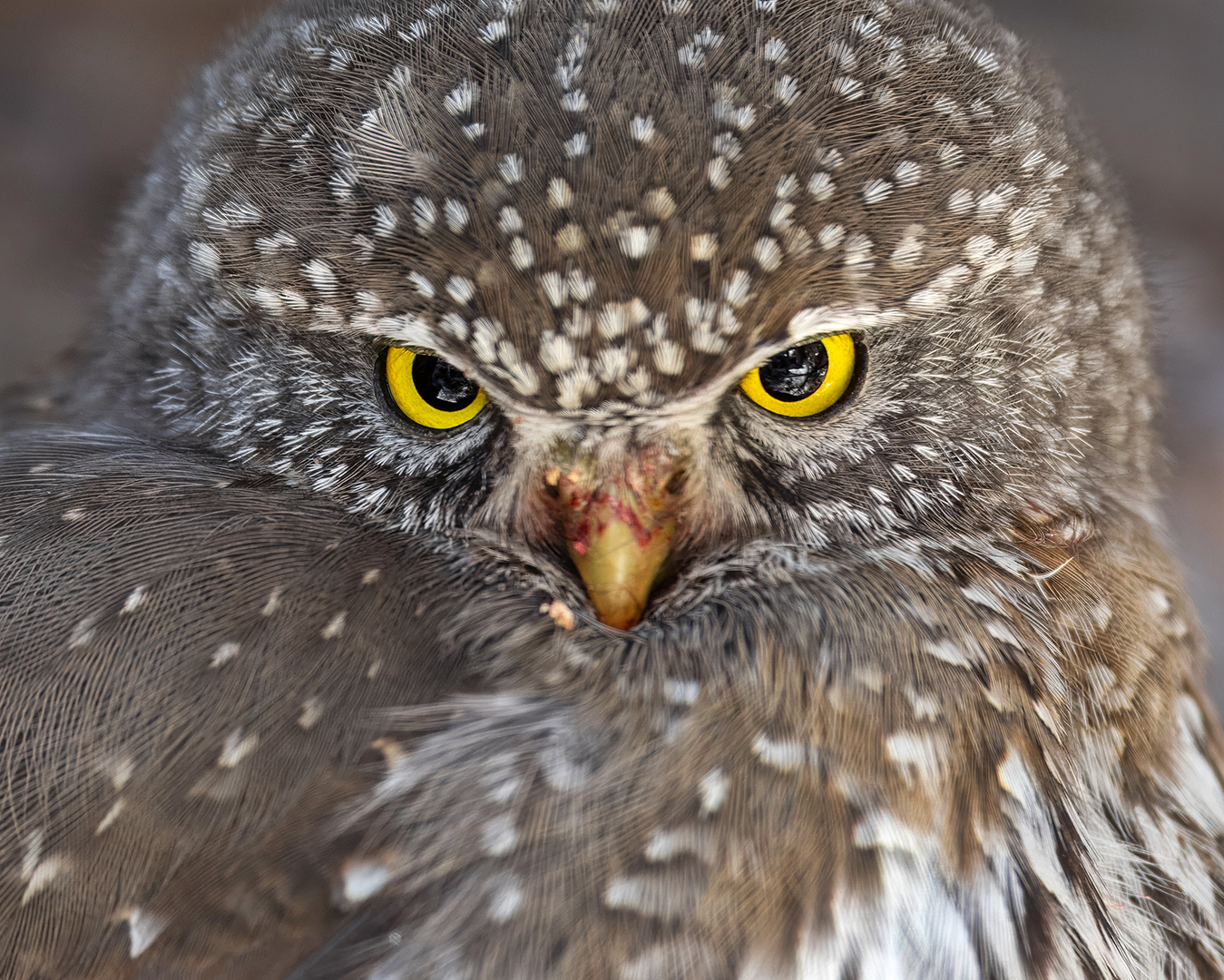
As their name implies, pygmy owls are tiny. Adults are about the size of a softball and don’t weigh much more than two ounces. Unlike most owls, pygmies hunt during the day. So far I’d only seen them catch rodents, but they also eat other birds and apparently can take down prey more than twice their size. I was smitten with these pint-sized killers.
Nick, who’d been out of town, returned to the park the next morning. Todd, Nick, and I split up to search, and soon I found the owl perched on a dead branch. I pulled out my phone to text Todd and Nick only to realize they’d already texted me: “Have visual on him.” That doesn’t make sense, I thought, there’s no way they can see the pygmy from where they are.
Oh wait, unless… “Are there 2 then?” I replied. There must be!
Eventually Nick and Todd’s owl flew off, so they came over to watch mine. We had a good view, and as we took photos there was sudden flurry of activity – Nick and Todd’s owl swooped in and seemed to attack my owl before taking off again.
Oh wait, unless… “Did they just mate?” I asked. It had happened in a matter of seconds.
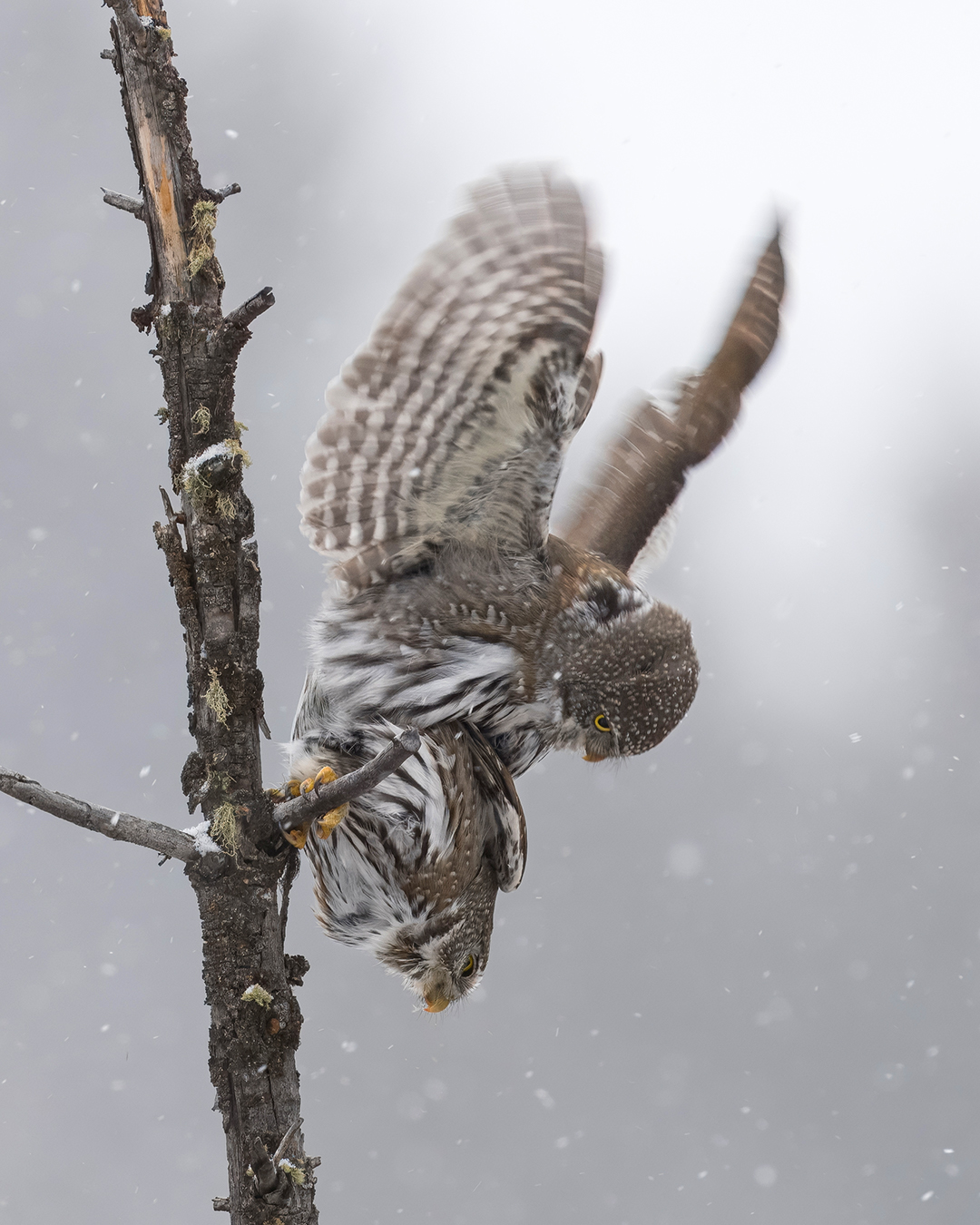
“Once in a lifetime, seeing that,” Nick declared. Not normally given to hyperbole, Nick probably ended up wishing he’d kept that thought to himself.
Later that day we lost our monopoly on the owls when a guide noticed us standing around and figured out what we were watching. He shared the sighting on his radio, and it wasn’t long before Lamar Canyon was clogged with people looking for a pygmy. The news appeared in Yellowstone Reports that night, making it widely known among guides and regulars.
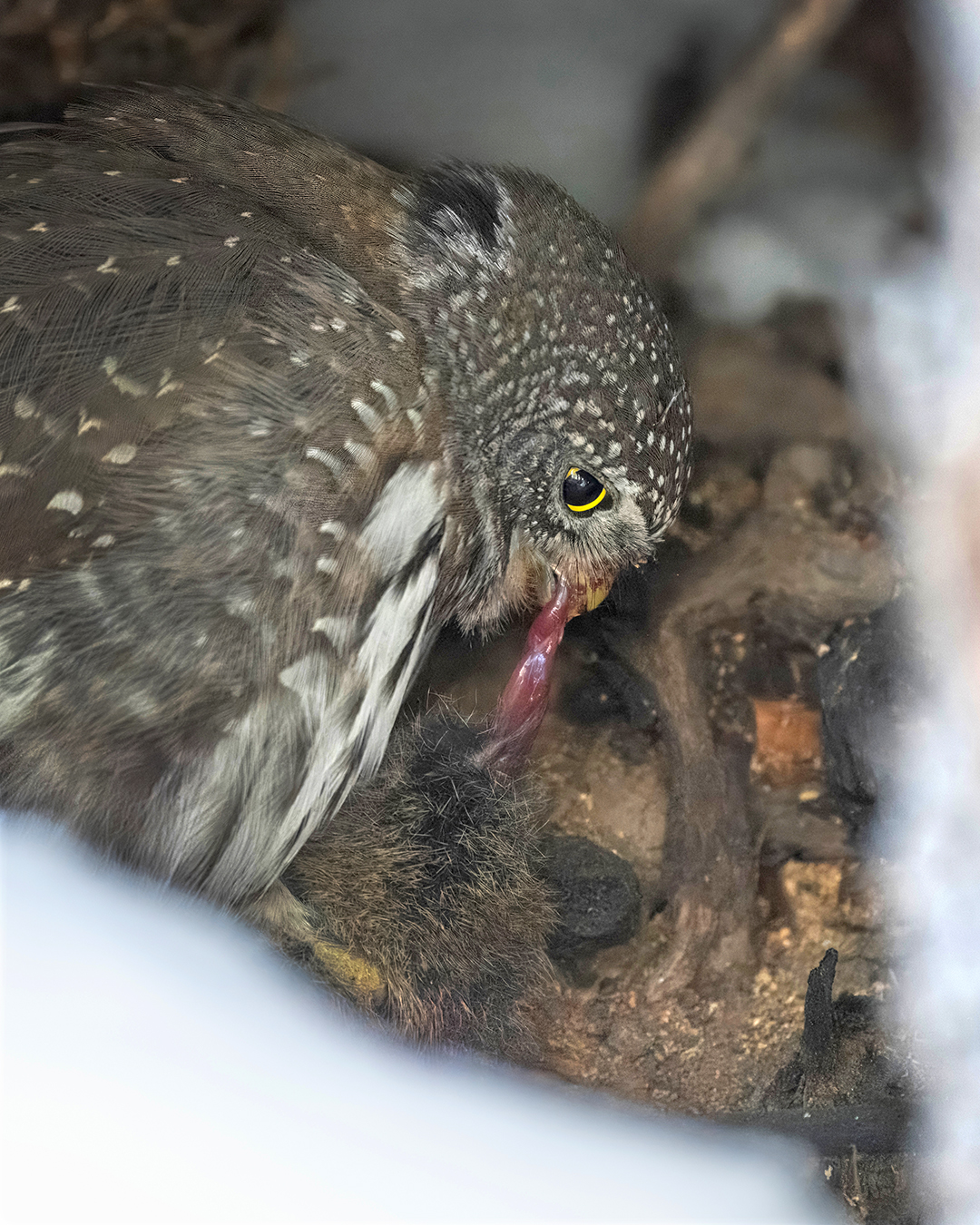
We found the owls every day for the next week. The growing crowds of fellow pygmy-watchers could be frustrating, but we still enjoyed an awesome run of encounters in a range of different weather and lighting conditions. We witnessed the owls mating so many times I lost count. One afternoon we were positioned in the right place when a pygmy dropped down into a dark hollow under a boulder, where it ate a rodent and tried to stay hidden from the other pygmy.





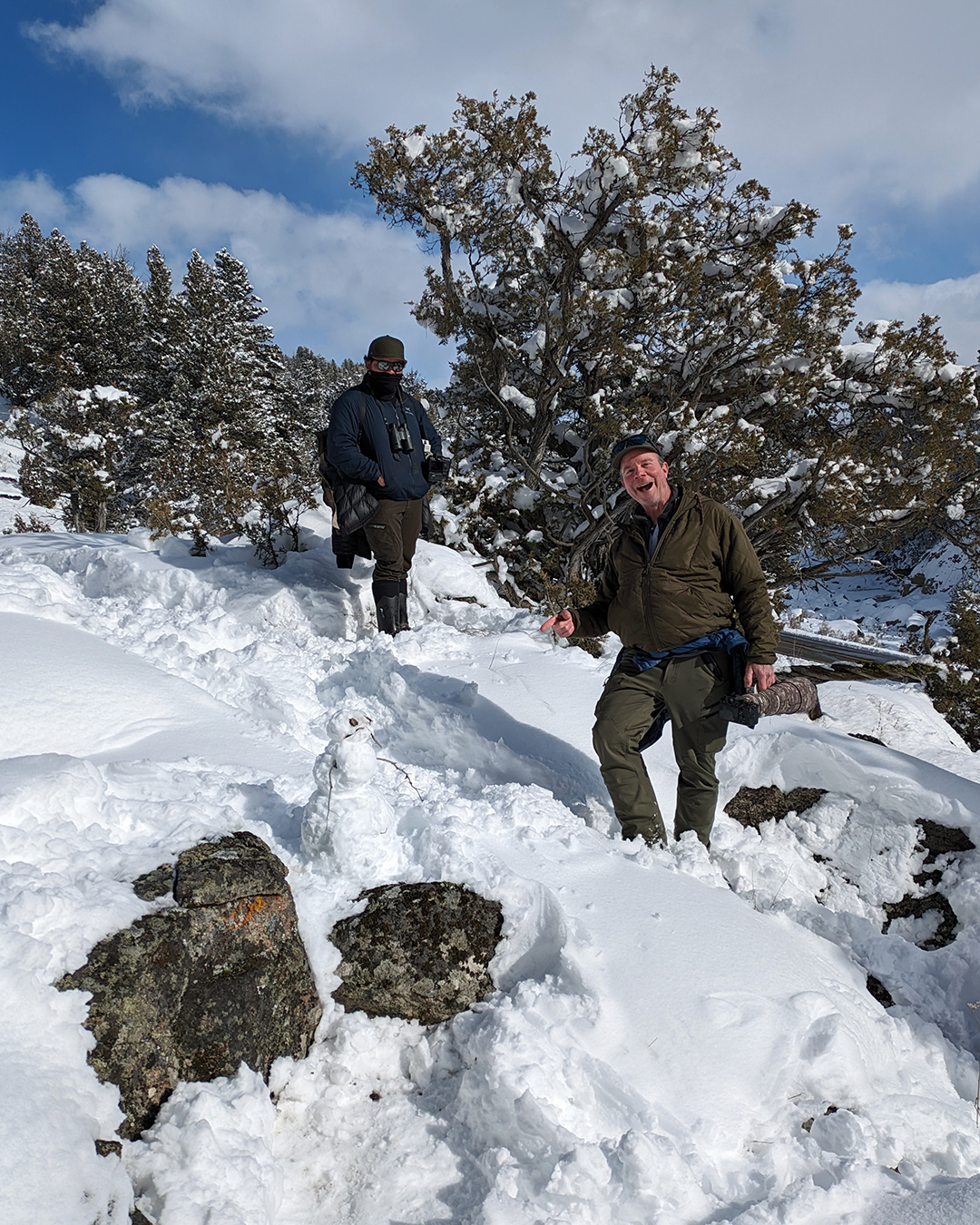
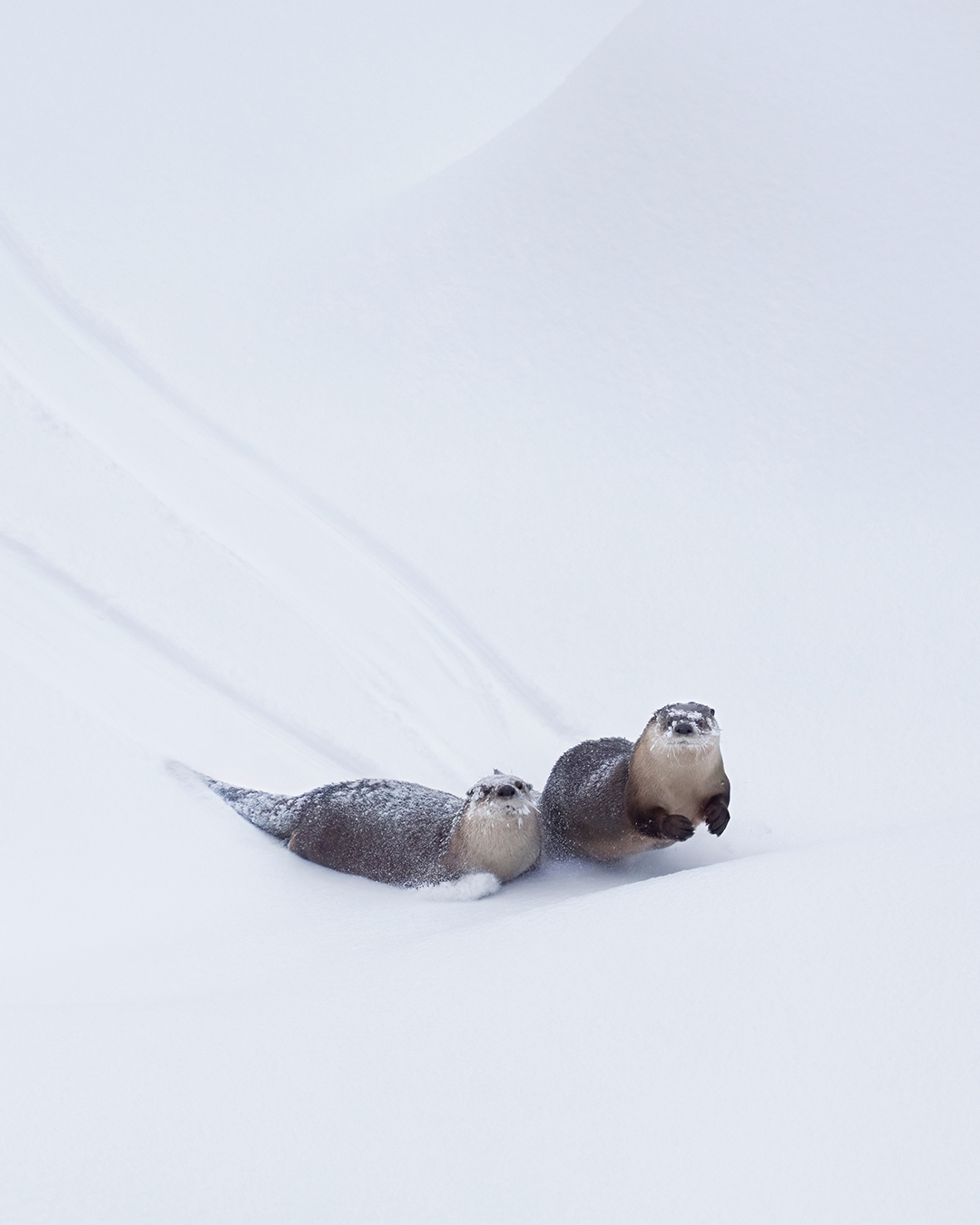
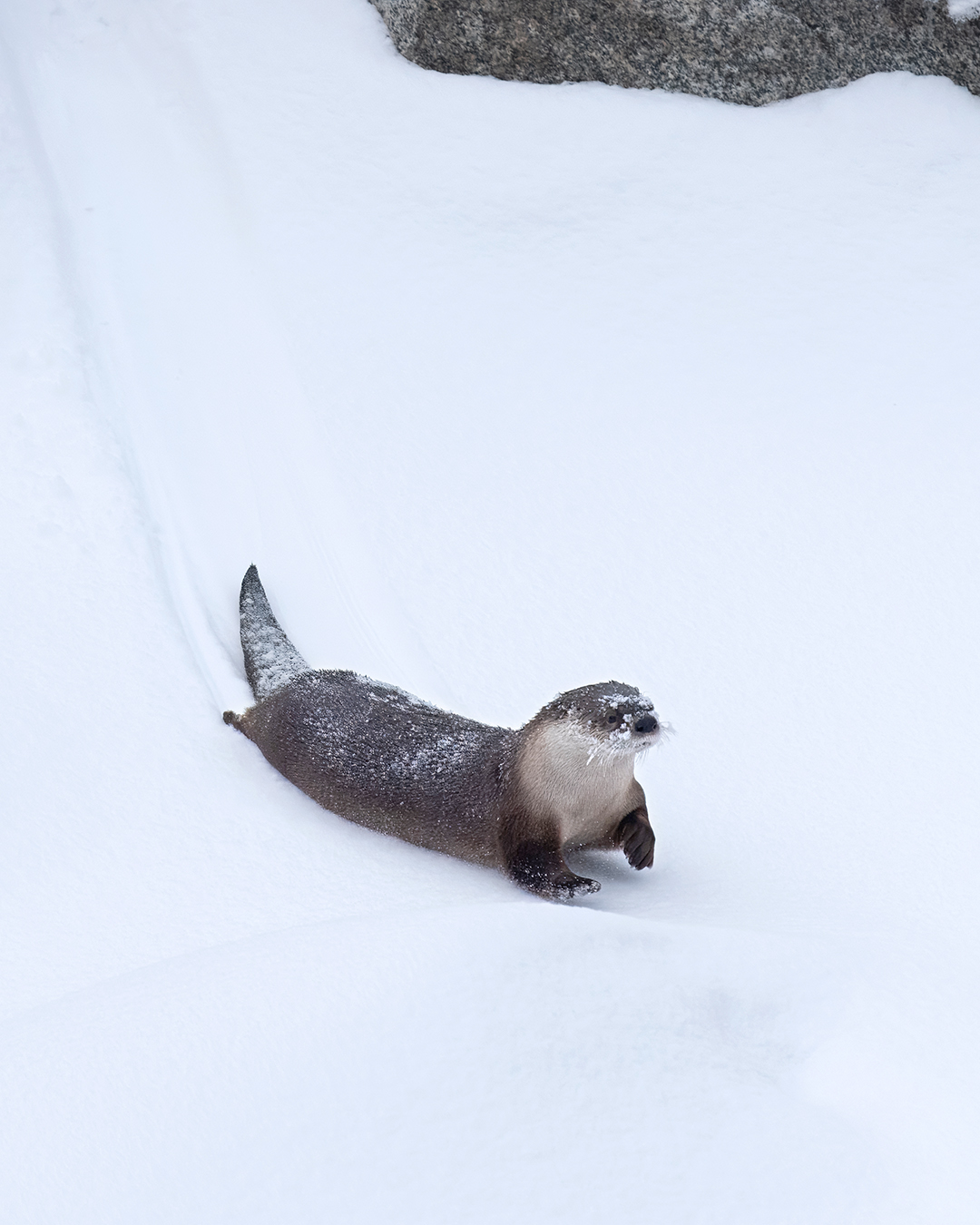
At one point I complained to Nick and Todd that we hadn’t seen any otters despite spending so much time next to the Lamar River. Turns out I just needed to be a little more patient. A few days later I was searching for the owls early on a cloudy morning when some distant movement caught my eye – two otters were sprinting and sliding across the blanket of snow that covered the mostly-frozen river. They zoomed right by like a couple of kids on a water slide. I think I laughed out loud. It was just the otter fix I needed.


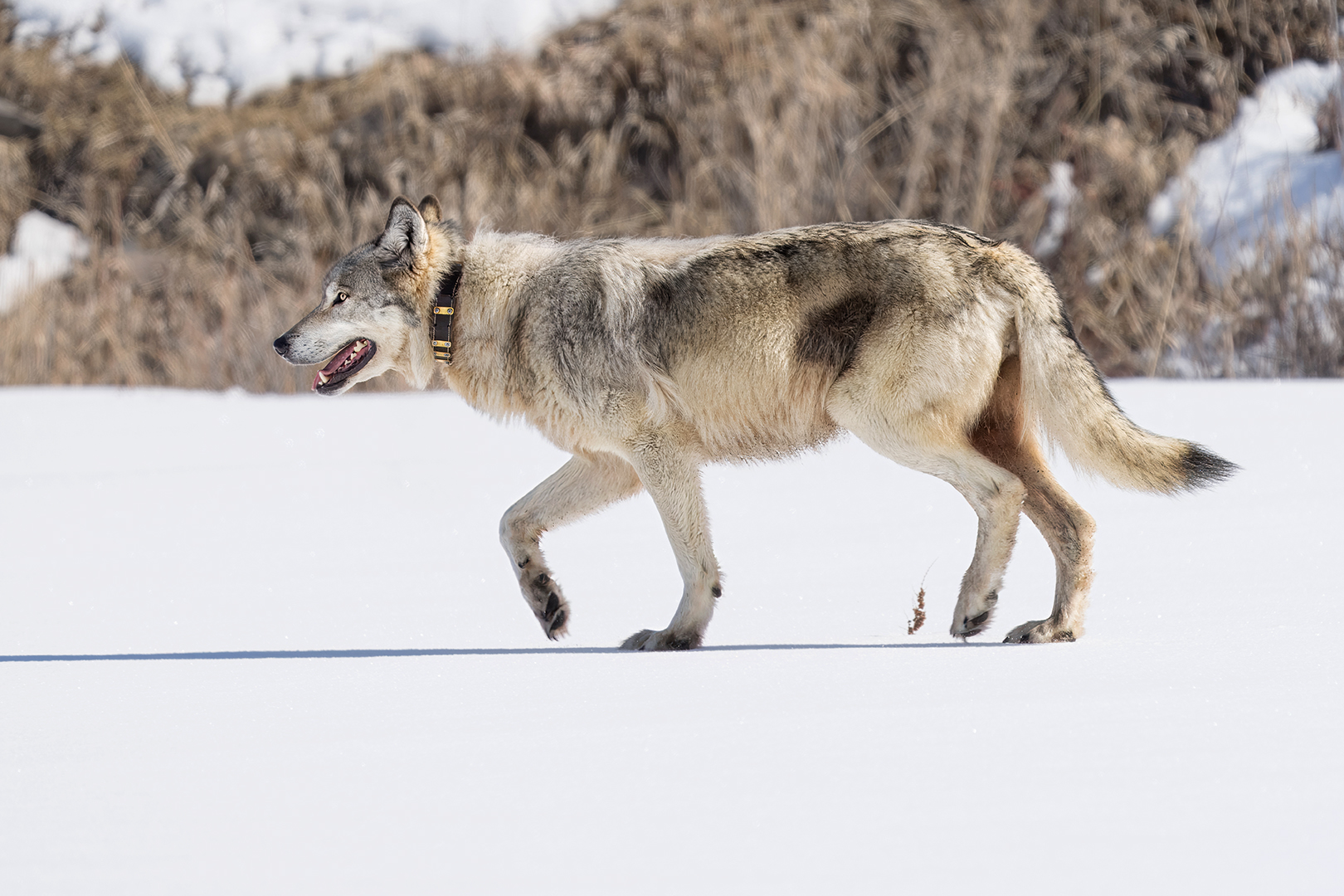
In mid-March Marie and I had a great visit from our niece Kate, who recently completed a life-event hat trick by moving to Livingston, adopting a dog, and starting a new job. Kate always seems to bring good wildlife luck, particularly with wolves. When she visited two years ago we had an unforgettable sighting of 1228, the alpha female of the Shrimp Lake pack and my favorite wolf in the park. This time Kate and I spotted two of 1228’s kids (a gray and a collared black) near Trout Lake, and later as we drove through Lamar Valley we saw 1228 herself trotting very close to the road.


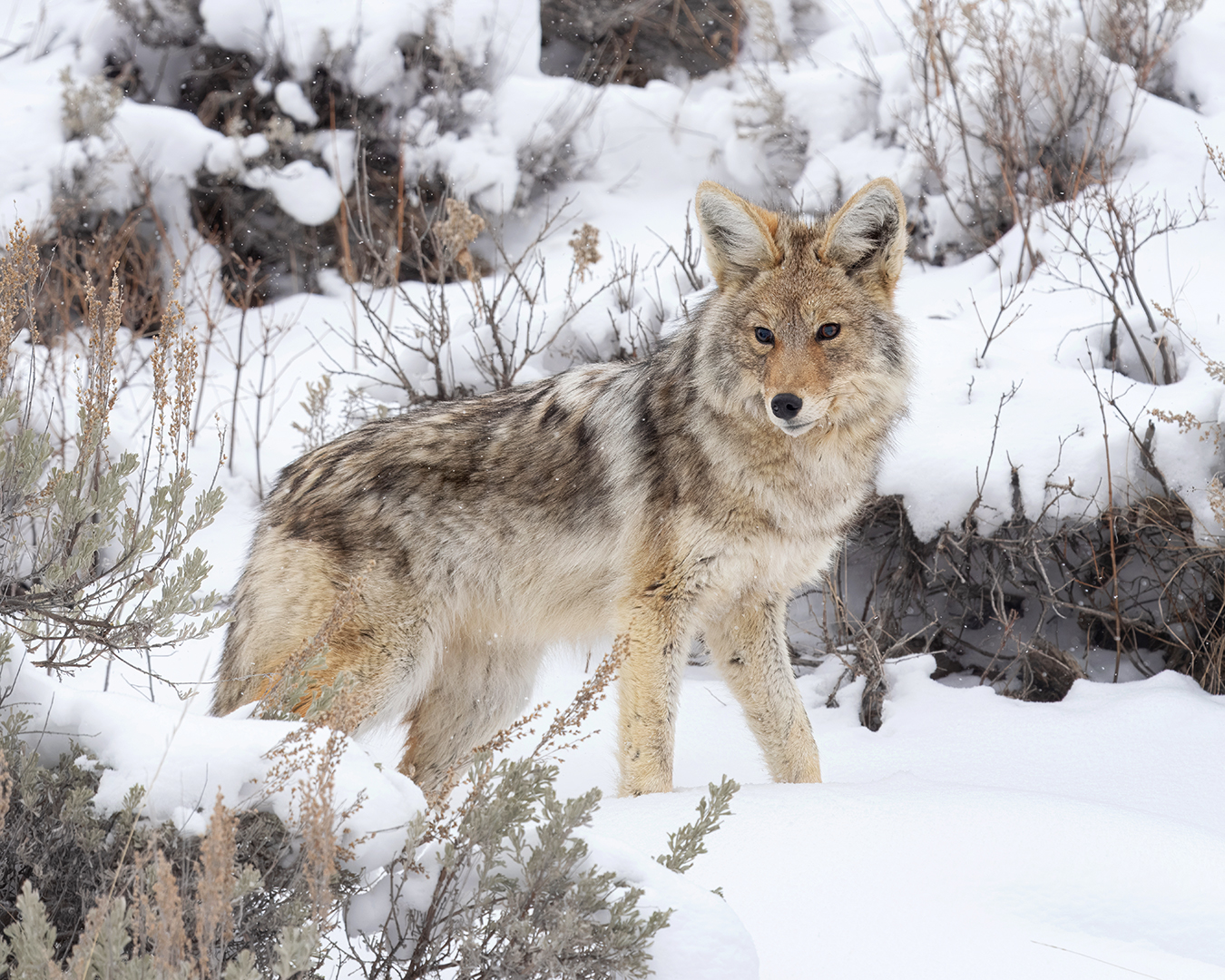

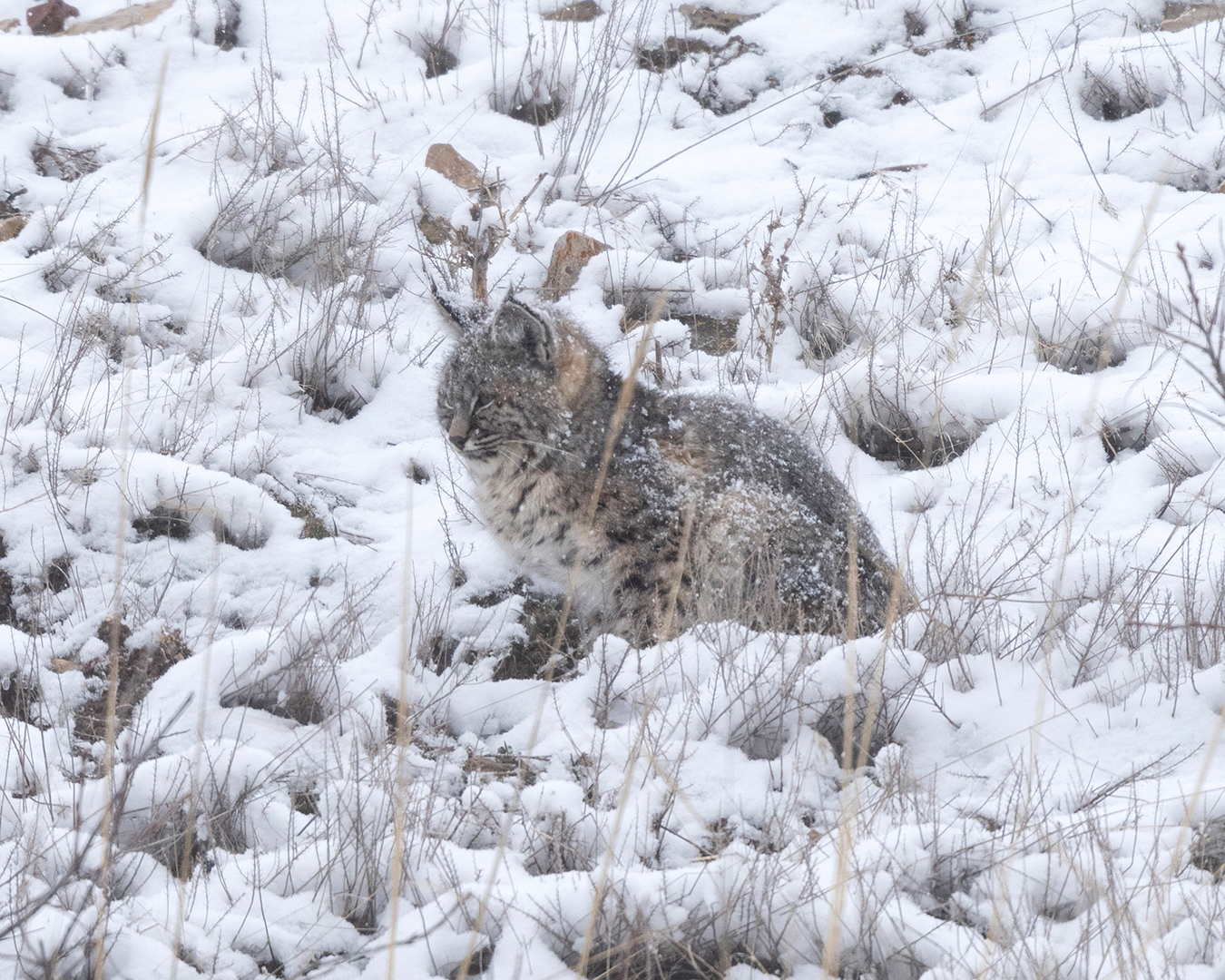
Not long after Kate’s visit there was a burst of non-pygmy-related excitement in Lamar Canyon when a bobcat made multiple appearances over the course of a few days. I kept missing it, which – given how much I’d been roaming around the area – drove me crazy. I’d seen a bobcat in Yosemite before but never in Yellowstone. Just when I thought I’d missed my chance, Jort spotted the cat at Confluence and was thoughtful enough to send me a message. Marie and I raced over and arrived in time to see it up high on a hillside, too far away for good photos but really fun to watch.
The pygmy owls in Lamar Canyon were tougher to spot during the second half of March, but I looked every morning and if I hung out long enough I eventually found them more often than not.

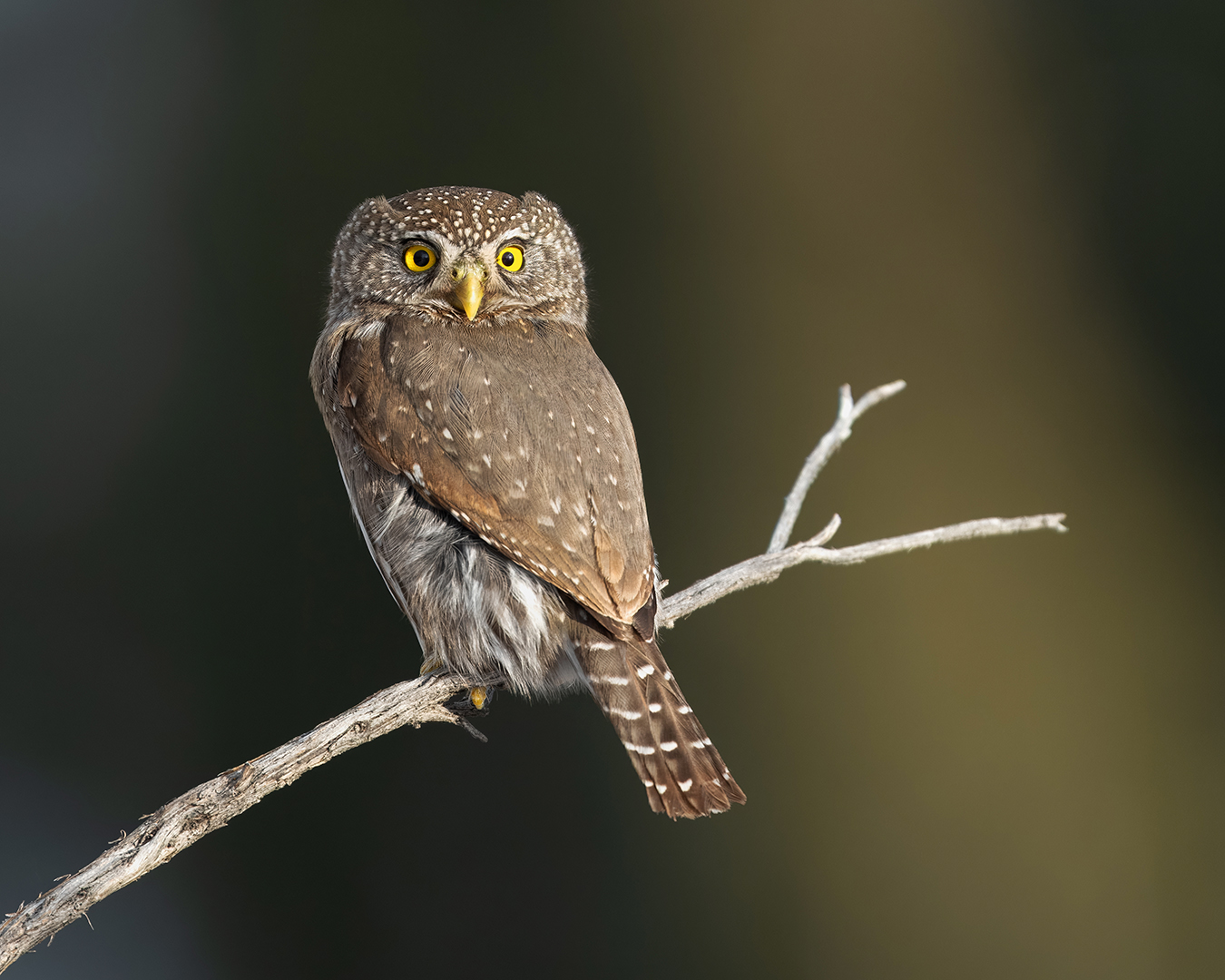


What a great month. Even if I’d been determined to resist Stage Three, spending so much time watching those fascinating little owls would have sealed my fate. Now I’m crossing my fingers that at some point in April or May we might actually see ultra-tiny pygmy chick faces peering out from a hole in a dead tree.
 endlessloopphotography.com
Wow Rob! Absolutely fantastic photos and narrative.
LikeLiked by 1 person
Thanks Carolyn!
LikeLike
Tried to comment earlier but think I was unsuccessful. So if this is a repeat, I apologize. I was thinking you were pretty bold invading the pygmy’s privacy and sending out pygmy pornography. 😉 As always, I love your great work and your description of your evolution as a wildlife photographer, now getting to smaller, finer things. Keep up the good work.
LikeLiked by 1 person
Ha, thanks, not much longer now and hopefully you’ll be seeing all the wildlife in person!
LikeLike
Anxious to see you and your critters.
LikeLiked by 1 person
Stunning Rob, love it!
LikeLiked by 1 person
Hey thanks Josh!
LikeLike